At the Harbour of Many Tongues
Updated: Mar 18
Pulau Brani and the Languages of the Nusantara
There are places where history is written in stone, and others where it lingers in memory. Pulau Brani belongs to the latter.
Standing today at the edge of Singapore’s southern harbour, it can be difficult to imagine the island as it once was. Container cranes now punctuate the skyline, and the waters around it carry the steady choreography of global shipping. Yet beneath this modern surface lies an older world: a maritime landscape shaped not only by trade and migration, but by language.
Pulau Brani existed within one of the most linguistically vibrant regions on earth. Long before Southeast Asia was divided into nation-states, the seas of the Nusantara formed a living network of movement connecting Sumatra, the Malay Peninsula, Borneo, Sulawesi, and beyond. Ships travelled with the monsoon winds. Sailors and merchants followed familiar routes between islands. And wherever these travellers gathered, languages gathered with them.
To think about Pulau Brani is therefore to think about sound.
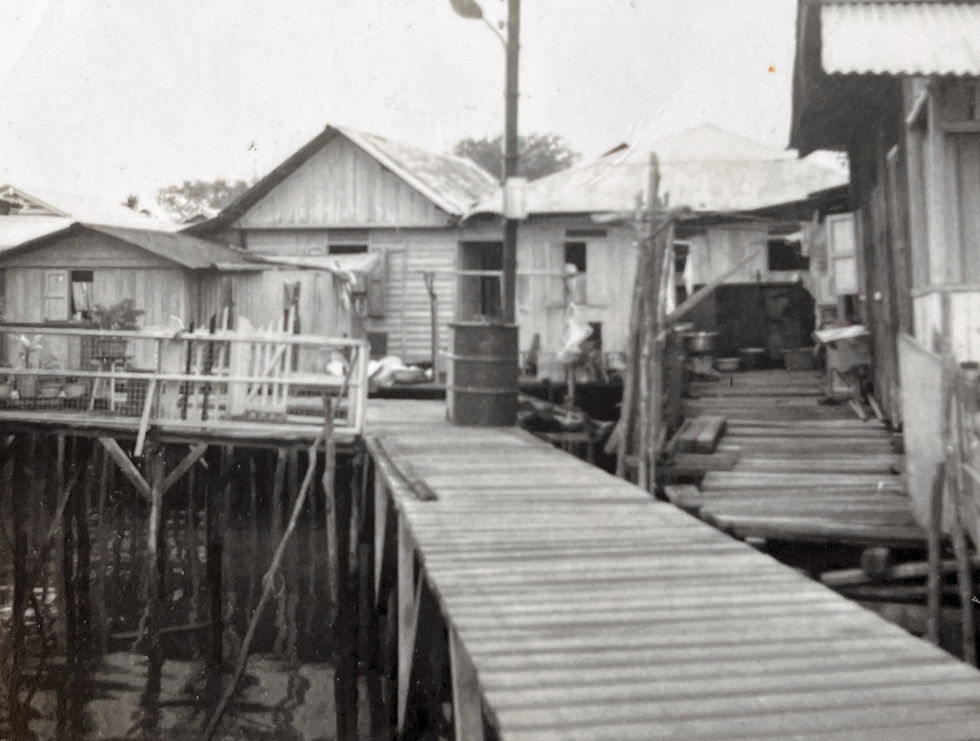
Not the mechanical hum of modern port machinery, but the voices that once carried across its shoreline: fishermen calling across the water, traders bargaining in markets, children running between wooden houses on stilts. Each voice carried its own linguistic inheritance. Together they formed a soundscape that was unmistakably Nusantara.
The Sea’s Common Language: Malay

If one language anchored this maritime world, it was Malay.
For centuries, Malay functioned as the connective language of the archipelago. Merchants arriving from distant islands, sailors navigating unfamiliar coasts, and travellers passing through port towns relied on Malay as a shared medium of exchange. [1]
Yet the Malay spoken in maritime markets was rarely formal or literary. It was flexible, practical, and open to borrowing—a form often referred to as Bazaar Malay. Words from Arabic, Tamil, Chinese, and later European languages entered its vocabulary, reflecting the diversity of people who spoke it.[2]
Malay therefore served not merely as a language of identity but as an infrastructure of connection. It allowed strangers to transact and neighbours to coexist. In the harbour settlements around Singapore, including Pulau Brani—it was almost certainly the language most widely understood.
But even as Malay connected communities, it also carried within it the linguistic traces of other worlds.
The Orang Laut: Languages of the Sea Peoples
Before Singapore emerged as a colonial port, the waters surrounding the island were home to communities known as the Orang Laut, or “people of the sea.”
The Orang Laut lived within the waterways of the Johor–Riau archipelago rather than on fixed land settlements. Their lives were shaped by tides, currents, and fishing grounds. Boats served as homes, and islands such as Pulau Brani formed part of a wider maritime landscape through which they moved. [3]
These communities spoke dialects closely related to Malay, yet their speech reflected the unique demands of maritime life. Their vocabularies included precise terms for currents, winds, reefs, and fishing techniques—knowledge accumulated through generations of seafaring experience.
The Orang Laut also occupied an important political role within earlier Malay polities. Their expertise in navigation made them valuable allies and guardians of sea routes. Linguistically, they were likely skilled at moving between dialects and broader Malay, enabling communication with traders and neighbouring communities.
To imagine Pulau Brani in its earliest centuries is therefore to imagine it within an Orang Laut seascape, where language flowed as fluidly as the tide.
Sailors of the Archipelago: Bugis Mobility
Another linguistic presence moving through the waters of the Nusantara came from the Bugis of South Sulawesi.
By the seventeenth century, Bugis traders and sailors had established vast maritime networks linking ports across the archipelago. Their ships travelled widely, carrying goods, stories, and languages between distant shores. [4]
Bugis sailors typically spoke their own language among themselves but adopted Malay when conducting trade with other communities. Such bilingualism was common among maritime traders, who navigated both physical and linguistic waters.
The southern islands around Singapore lay within these maritime circuits. Even where Bugis communities did not permanently settle, their vessels passed through the straits, reinforcing the archipelago’s shared linguistic ecosystem.
Languages in the Nusantara were rarely static. They travelled with ships.
Tamil and the Indian Ocean World
Across the Bay of Bengal, another linguistic tradition flowed into Southeast Asia.
Tamil-speaking merchants had been active in regional trade for centuries, linking South India with the ports of the Malay world. Merchant guilds established networks that stretched across the Indian Ocean, carrying textiles, spices, metals, and ideas between continents. [5]
When Singapore emerged as a British free port in the nineteenth century, Tamil-speaking migrants arrived in increasing numbers as traders, labourers, and administrators. Tamil became one of the languages heard in the growing port city.
The influence of Tamil also appears within Malay vocabulary itself. Words relating to commerce, textiles, and everyday objects reveal South Asian origins, reflecting centuries of maritime exchange.
Through Tamil, the harbour around Pulau Brani was connected not only to the archipelago but to the wider Indian Ocean.
Arabic and the Language of Faith
Where commerce brought Tamil across the ocean, faith carried Arabic.
Islam spread gradually through maritime Southeast Asia beginning in the thirteenth century, largely through the activities of traders and scholars moving along established sea routes. [6] With Islam came Arabic vocabulary relating to religion, governance, and scholarship. These words entered Malay and became embedded in the language.
The Arabic script was adapted into Jawi, a writing system used widely across the Malay world. Through Jawi manuscripts, religious texts, legal documents, and literature circulated between ports and villages.
Even where Arabic was not spoken conversationally, it shaped the intellectual and spiritual vocabulary of the region. In settlements around Pulau Brani, the cadence of Qur’anic recitation would likely have been familiar.
Thus the harbour’s linguistic landscape was shaped not only by trade but also by faith.

Chinese Languages in the Harbour
By the nineteenth century, another powerful linguistic presence had arrived in Singapore’s harbour: migrants from southern China.
These migrants brought with them a range of languages and dialects, including Hokkien, Teochew, Cantonese, and Hakka. Many worked in shipping, trade, and labour tied to the expanding port economy. [7]
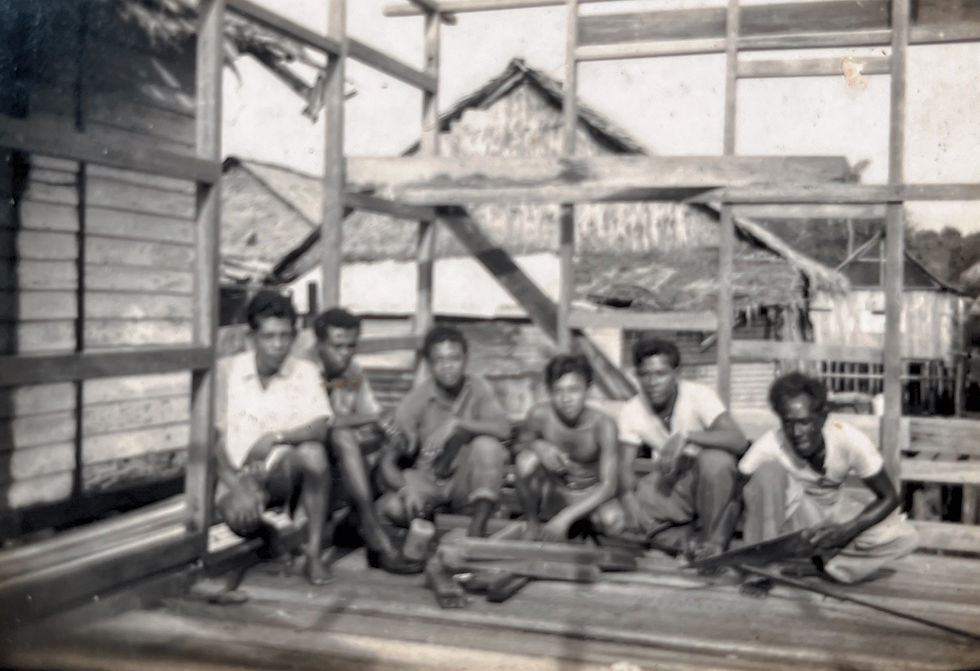
Historical accounts suggest that Pulau Brani itself once housed both Malay and Chinese residents living in coastal villages. In such communities, daily life would have involved constant linguistic negotiation.
Chinese migrants often maintained their native dialects within family networks while using Malay, or later English, to communicate with other communities.
This multilingual environment became a defining characteristic of Singapore’s harbour settlements.
Naming the Islands: The Language of Place
Place names often preserve linguistic history long after other traces have disappeared.
Pulau Brani itself carries a Malay name. The word berani means “brave,” leading to one widely cited interpretation of the island as the “Island of the Brave.” [8]
Nearby islands offer similarly layered histories. Pulau Blakang Mati, the former name of present-day Sentosa, has been interpreted in various ways, sometimes associated with geographical positioning behind Brani, sometimes linked to older oral traditions or historical events. [9]
Such debates remind us that place names are rarely simple. They reflect layers of translation between languages, oral histories, and colonial mapping practices.
In the southern islands, the geography itself becomes a linguistic archive.
A Harbour Remembered: Voices from Kampong Brani
For many families who once lived on Pulau Brani, language was inseparable from daily life.
Former residents of Kampong Brani and Telok Saga often recall a community where Malay served as the common language of the neighbourhood, yet where many other linguistic influences were present. Chinese neighbours spoke dialects at home, Tamil workers passed through the harbour, and religious life carried Arabic expressions familiar to Muslim families.
In oral histories recorded in later decades, residents describe an island where children moved easily between households and languages—borrowing words, accents, and expressions without thinking twice about it.
In such communities, multilingualism was not an academic concept, just simply how life worked.
Traces in the Language
One of the most fascinating features of Malay is how it preserves the linguistic traces of centuries of interaction.
Malay Word | Origin | Meaning |
kedai | Tamil | shop |
kapal | Tamil | ship |
kitab | Arabic | book |
hakim | Arabic | judge |
tauke | Hokkien | merchant / boss |
mee | Chinese | noodles |
These borrowed words are reminders that languages in the Nusantara were never isolated. They evolved through contact.
In many ways, Malay itself is an archive of maritime history.
Pulau Brani as a Microcosm of the Nusantara
In many ways, Pulau Brani offers a small but revealing window into the larger world of the Nusantara.
The Malay term Nusantara - often understood as the island world of Southeast Asia - does not describe a single civilisation or language. Instead, it refers to a maritime system shaped by movement. Islands were never isolated points of land; they were nodes in a web of exchange connecting seas, rivers, and people.
Within this archipelagic geography, language functioned as a form of navigation.
Malay allowed strangers to trade across cultural boundaries. Bugis sailors carried their language through maritime routes linking Sulawesi with the Malay Peninsula. Tamil merchants connected the archipelago to the wider Indian Ocean. Arabic infused the vocabulary of faith and scholarship. Chinese migrants brought the languages of southern coastal provinces into the bustling port cities of Southeast Asia.
Pulau Brani sat quietly within this network. Yet its small size makes it an unusually clear lens through which to observe these overlapping linguistic currents.
A kampong child on Brani might have spoken Malay at home, heard Hokkien or Teochew in neighbouring houses, recognised Arabic phrases in religious life, and encountered Tamil speakers working in the harbour. None of these linguistic encounters would have seemed extraordinary. They were simply part of life in a maritime society where languages flowed as freely as tides.
This fluidity was one of the defining characteristics of the Nusantara. Unlike continental societies where languages often developed within fixed territorial boundaries, the languages of the archipelago evolved through movement. Trade routes, pilgrimage journeys, fishing grounds, and seasonal winds shaped linguistic exchange.
Language therefore became not only a tool of communication but a record of encounter.
Malay itself bears the imprint of these encounters. Its vocabulary contains Arabic words reflecting Islamic scholarship, Tamil terms tied to commerce and craft, Chinese expressions associated with trade, and European borrowings introduced through colonial contact. Each borrowed word is a small fragment of maritime history embedded within everyday speech.
Pulau Brani reminds us that such exchanges were not abstract processes unfolding across maps. They occurred in ordinary places: along shorelines, in markets, on fishing boats, and within kampong households.
Seen from this perspective, the island becomes more than a geographic location. It becomes a linguistic crossroads, where the languages of the archipelago briefly converged before continuing their journeys across the sea.
Today, the physical traces of that world have largely disappeared. The kampongs of Pulau Brani are gone, and the island now forms part of Singapore’s modern port infrastructure. Yet the multilingual heritage of the Nusantara remains deeply embedded in the region’s cultures and languages.
To listen carefully to Malay, or to the linguistic diversity of Singapore itself, is to hear echoes of that older maritime world.
And perhaps this is the deeper lesson Pulau Brani offers us: that the history of the Nusantara cannot be fully understood through monuments or maps alone.
Sometimes, its history survives most clearly in language, in the words people borrow, adapt, and carry with them across water.

Listening to the Harbour Again
Today, little remains of the kampongs that once stood on Pulau Brani. The island has been transformed by port infrastructure, and the wooden houses along its shore have disappeared.
Yet the linguistic world that surrounded Pulau Brani has not vanished entirely. It survives in fragments - in the vocabulary of Malay, in place names scattered across the southern islands, and in the multilingual character that continues to define Singapore.
To imagine Pulau Brani in its earlier centuries is therefore to imagine not silence but conversation.
Voices calling across the water.
Languages blending in marketplaces.
Prayers carried by the wind from a nearby surau.
In the end, the island’s deepest history may not lie in its buildings or boundaries, but in the languages that once met at its shore.
Footnotes
Anthony Reid, Southeast Asia in the Age of Commerce 1450–1680.
Encyclopaedia Britannica, “Malay Language.”
National Library Board Singapore, Orang Laut.
Leonard Andaya, The Heritage of Arung Palakka: A History of South Sulawesi.
Kenneth Hall, Maritime Trade and State Development in Early Southeast Asia.
Azyumardi Azra, The Origins of Islamic Reformism in Southeast Asia.
Carl Trocki, Singapore: Wealth, Power and the Culture of Control.
National Library Board Singapore, Pulau Brani.
Cacciafoco & Shia, “Singapore’s Pre-Colonial Place Names.”
Bibliography
Andaya, Leonard. The Heritage of Arung Palakka: A History of South Sulawesi.
Azra, Azyumardi. The Origins of Islamic Reformism in Southeast Asia.
Britannica. “Malay Language.”
Hall, Kenneth. Maritime Trade and State Development in Early Southeast Asia.
Reid, Anthony. Southeast Asia in the Age of Commerce 1450–1680.
Trocki, Carl. Singapore: Wealth, Power and the Culture of Control.
National Library Board Singapore. Pulau Brani.
National Library Board Singapore. Orang Laut.
Cacciafoco, Francesco Perono & Shia, Andrew. “Singapore’s Pre-Colonial Place Names.”